
Writing C1 Advanced (CAE) - Guide
What the C1 Advanced Writing is like
Since 2015, the CAE Writing paper has followed the same structure as the other Cambridge exams. Candidates are required to write two texts of 220–260 words within 1 hour and 30 minutes. These texts must be of different types, as we will explain in the next section. The aim is to demonstrate a range of writing skills and language features appropriate to C1 level.
Next, we will examine the different types of tasks included in the C1 Advanced (CAE) Writing paper, along with examples of each.
Types of C1 Writing tasks
These are the different types of task you may encounter in the current CAE Writing:
- Part 1
- Essay (mandatory)
- Part 2
- Email (informal or formal) or letter (informal or formal)
- Review
- Report
- *Proposal
*These types of Writing tasks have been present since B2 First, except for the proposal, which is a new type of Writing task introduced at CAE (C1 level), and which replaces the article, which disappears at this level.
Writing C1 Advanced: Part 1- Essay
As in the other Cambridge Main Suite exams, the first part of the Writing paper requires you to write an essay. Unlike Part 2, there is no choice of task in this section, so all candidates must complete the essay.
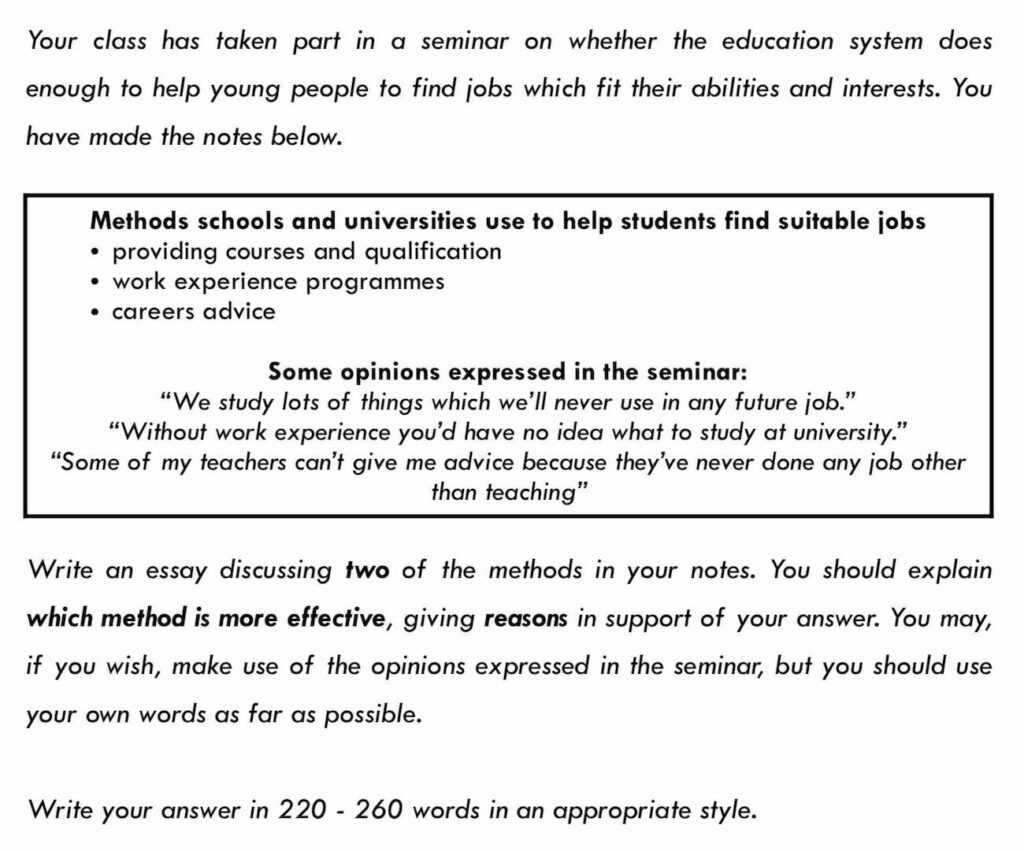
As you may already know, the essay is a common C1-level writing task, especially in academic contexts, which is one of the main focuses of this exam. Although the word limit is relatively short (up to 260 words), the goal is to show that you can write confidently and effectively about academic topics. To help candidates, the task instructions always follow the same format and include the same number of points to address.
Below, you can see a screenshot showing what the instructions for a CAE essay typically look like:
Example for Writing C1 Advanced: Essay
Helping Students Find Suitable Jobs
Nowadays, there is a significant issue within our education system. An increasing number of young people end up working in jobs that are unrelated to their university degrees. As a result, dissatisfaction and unemployment are rising, since many young employees eventually leave their positions. The question is whether anything can be done to address this situation. Many experts argue that solutions are available.
On the one hand, some believe that students are often too inexperienced when they choose their degree programmes. At that stage of their lives, they may not fully understand their interests, strengths, or long-term goals. If they had the opportunity to gain practical experience before making such important decisions, they might make more informed choices. Consequently, this could reduce the number of university dropouts and increase overall job satisfaction. For this reason, introducing work experience programmes before or during university studies could be highly beneficial.
On the other hand, research suggests that students do not receive adequate careers guidance at school. Teachers are not always properly trained to provide professional advice, and schools may lack the necessary resources. Therefore, employing qualified careers counsellors could help students develop realistic expectations and make better-informed decisions about their future.
In conclusion, addressing both issues would improve the effectiveness of the education system in preparing students for the world of work. However, I believe that gaining practical experience would be more beneficial than relying solely on professional advice, as personal experience often provides deeper and more lasting insights.
Writing C1 Advanced: Part 2
In this part of the exam, you are required to write a second text of 220–260 words. However, unlike Part 1, you can choose from three different task options. Be careful, though: even though only three tasks are provided, they may represent any of the seven possible C1 Writing types mentioned earlier, such as a review, a formal letter or email, an informal letter or email, a report, or a proposal.
Writing C1 Advanced: Review
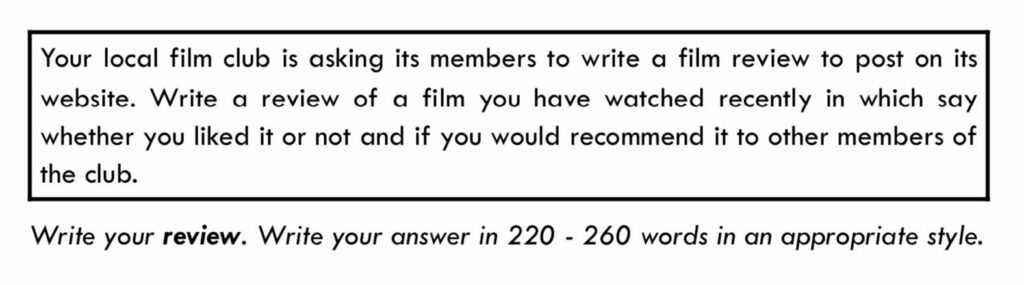
One of the writing tasks that may appear in the C1 Advanced exam is a review. In my opinion, this can be quite a challenging task, as it requires a specific style and structure. You might be asked to write a review of a film, a book, a TV series, a product, a website, or a television programme, among other possibilities. In this section, we will look at an example of instructions for writing a film review.
Example for Writing C1 Advanced: Review
The Lord of the Rings
Few film trilogies have had the cultural impact and lasting appeal of The Lord of the Rings, directed by Peter Jackson. Based on J.R.R. Tolkien’s epic novels, these films set a new standard for fantasy cinema and continue to captivate audiences years after their release.
Set in the richly imagined world of Middle-earth, the story follows Frodo Baggins, a humble hobbit entrusted with the dangerous mission of destroying a powerful ring. Accompanied by a diverse fellowship of allies, Frodo embarks on a journey filled with breathtaking landscapes, terrifying enemies, and moments of deep friendship and sacrifice. While the plot revolves around the struggle between good and evil, the heart of the trilogy lies in its exploration of loyalty, courage, and hope in the face of overwhelming darkness.
The performances are outstanding throughout. Elijah Wood brings sensitivity and determination to the role of Frodo, while Viggo Mortensen’s portrayal of Aragorn perfectly captures the qualities of a reluctant yet noble leader. The supporting cast, including Ian McKellen as Gandalf, adds depth and gravitas to the story. Combined with groundbreaking visual effects and a magnificent musical score by Howard Shore, the trilogy creates an unforgettable cinematic experience.
What makes The Lord of the Rings truly exceptional is its emotional depth. Beyond the epic battles and stunning visuals, it reminds viewers that even the smallest person can change the course of the future.
If you enjoy adventure, fantasy, and powerful storytelling, this trilogy is an absolute must-watch
Writing C1 Advanced: Report
In my opinion, the report is one of the more straightforward C1 Writing tasks. This is mainly because it requires less creativity than other text types, which often makes it easier and allows us to concentrate more on using accurate and appropriate written English.
A report is essentially a factual account. In other words, it is a piece of writing in which we analyse a situation, event, or issue that already exists or has taken place. For instance, you might be asked to write a report about a school visit, an exchange programme, a company, or a particular situation in your country.
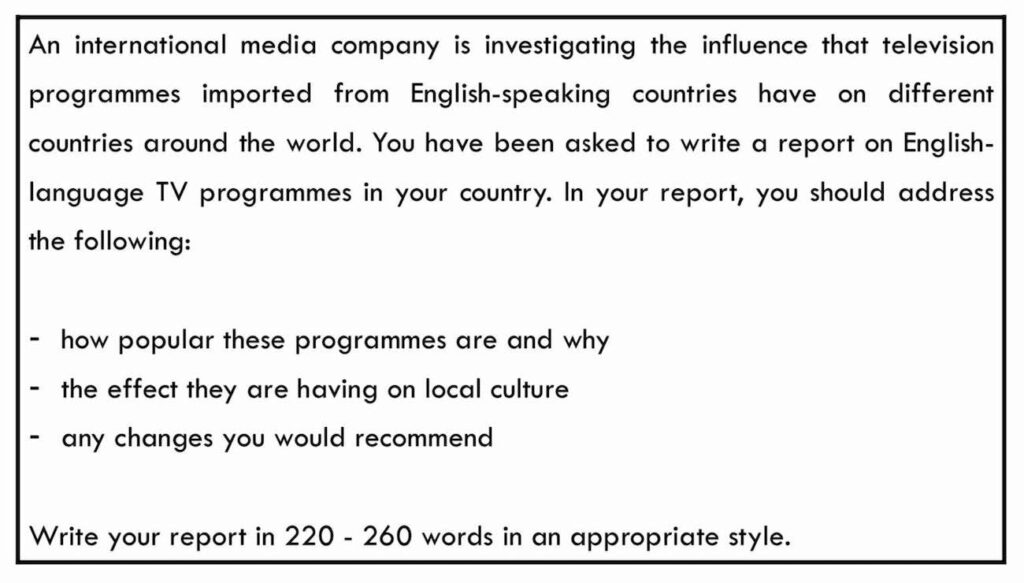
In the example below, the task involves writing a report on the influence of English-language television programmes in your country. Read the instructions carefully:
Example for Writing C1 Advanced: Report
English-Language TV Programmes in Argentina
Introduction
This report aims to examine the presence of English-language TV programmes on Argentine television. It focuses on their popularity, their effects on local culture, and possible improvements that could enhance their impact.
Popularity
Recent studies indicate that English-language TV programmes have become increasingly popular in Argentina over the past decade, largely due to innovations such as on-demand viewing. Most viewers currently watch dubbed versions of these shows. However, as English proficiency continues to grow in the country, a rising number of viewers are choosing the original English versions to improve their language skills and gain a more authentic viewing experience.
Effects on Local Culture
Although the influence on Argentine culture is relatively limited compared to other countries, some effects have been observed. National productions often struggle to compete with American programmes, which typically have larger budgets and higher production values. On the other hand, sociologists note that viewers who watch shows in English benefit not only from language exposure but also from increased cultural awareness, helping them understand different perspectives and lifestyles.
Recommendations
To maximise the benefits of English-language programmes, I recommend reducing or eliminating dubbing. This would encourage viewers to watch content in English, thereby improving their language skills. Additionally, Argentine TV channels could offer online educational materials and guidance to support viewers, making it easier for them to follow and learn from the original versions. These measures would help English-language shows contribute positively to both language development and cultural enrichment in Argentina.