Writing B1 Preliminary (PET) - Guide
What’s in the Writing test?
The B1 Preliminary for Schools and B1 Preliminary Writing tests have two parts. You have to show that you can write different types of text in English.
Part 1 (Writing an email)
Write about 100 words, answering the email and notes provided.
Part 2 (Choice between an article or a story)
Write about 100 words, answering the question of their choosing.
*In the Writing section of the PET exam, candidates have to complete two parts in a total of 45 minutes. I recommend spending about 20 minutes on each part and using the last 5 minutes to check your work. Use this time to review spelling, punctuation and grammar.
Writing B1 Preliminary (PET) How is it assessed?
Content:
This criterion evaluates how well you have completed the task. In other words, it checks whether you have answered all parts of the question. It is important to address every point mentioned in the task and to provide enough relevant information to fully develop each idea.
Communicative Achievement:
This focuses on how appropriate your writing is for the task. You need to use the correct style and register. At B1 level, this usually means writing in a clear and natural way, often using familiar language, as you may be communicating with a friend or family member.
Organisation:
This assesses how clearly and logically your writing is structured. Your text should be well organised, with connected paragraphs and sentences that flow smoothly. Using suitable B1-level linking words and connectors will help create a coherent and easy-to-follow text.
Language:
This criterion evaluates your use of grammar and vocabulary. You are expected to use language appropriate for B1 level and to avoid frequent or serious mistakes that could make your writing difficult to understand.
Writing B1 Preliminary: Part 1 – Email
In the first part of the Writing exam, you have to write an email of about 100 words. “About” means you don’t need to write exactly 100 words. Writing between 80 and 120 words is fine, so don’t worry too much about the number.
You must reply to an email using some notes that you have written.
To write a good email in the B1 exam, it is important to know this type of task. Let’s look at an example from the 2020 PET exam to see the instructions.
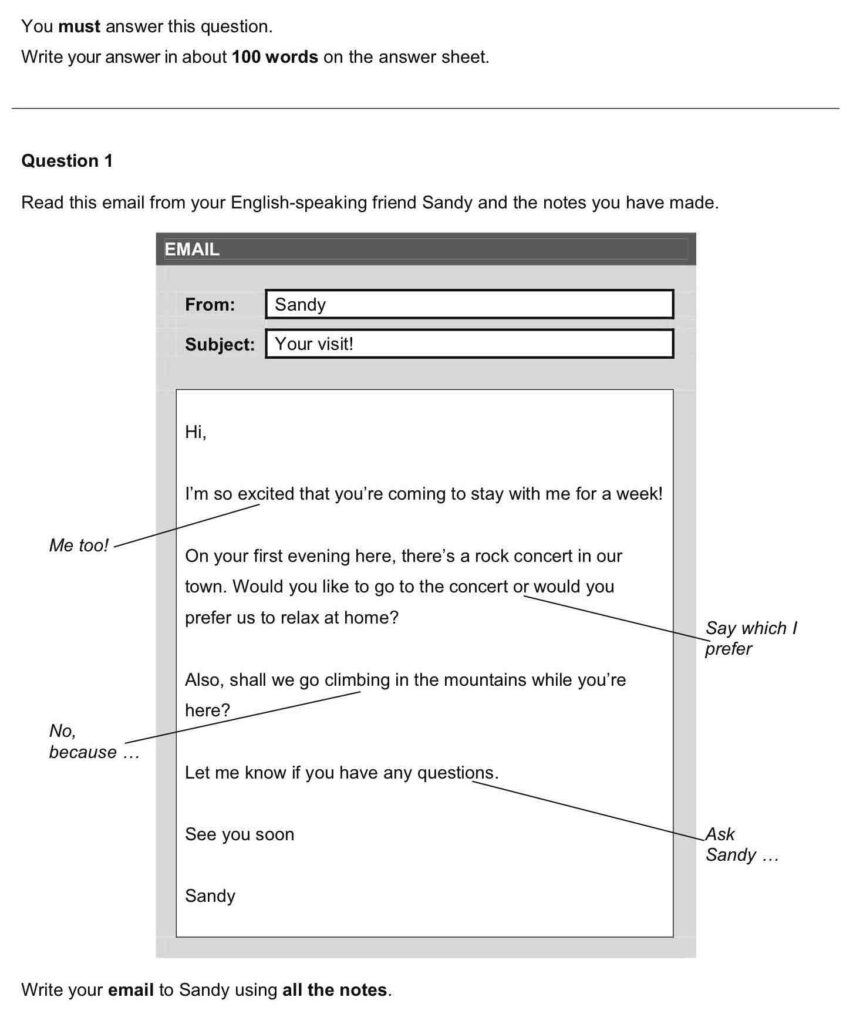
Example of Writing B1 Part 1: Email
Hi Sandy,
Thanks for your email. I’m really looking forward to visiting you.
On the first evening, I would like to stay at home and relax. I think I will be very tired after the journey, so I need to rest. I hope that’s OK.
About climbing, I’m sorry but I can’t do it. I hurt my knee last week, so I can’t do any sport at the moment.
We could visit some art galleries in your town because I really like art. What do you think?
Write back soon and tell me your ideas.
Best wishes,
Ale Yass
Great. Now we have an example of a B1 Writing email. As you can see, an email has a clear structure:
Greeting: Hi Sandy,
Introductory paragraph: Thanks for your email.
Idea 1 (Say what you prefer): On the first evening, I would like to stay at home and relax.
Idea 2 (Say no and give a reason): About climbing, I’m sorry but I can’t do it because I hurt my knee.
Idea 3 (Make a suggestion): We could visit some art galleries in your town.
Closing paragraph: Write back soon and tell me your ideas.
Farewell: Best wishes,
Signature: Ale
The good thing about writing an email at B1 level is that all emails usually follow the same structure. Because of this, you can prepare some parts and useful phrases before the exam. This makes writing the email easier and faster.
Writing B1 Preliminary: Part 2
In this part of the exam, you have to write another text of about 100 words. However, you only need to choose one option.
You can choose either:
– an article, or
– a story
Let’s now see what the instructions for the article of the B1 Writing Part 2 are like:
Writing B1 Preliminary: Article
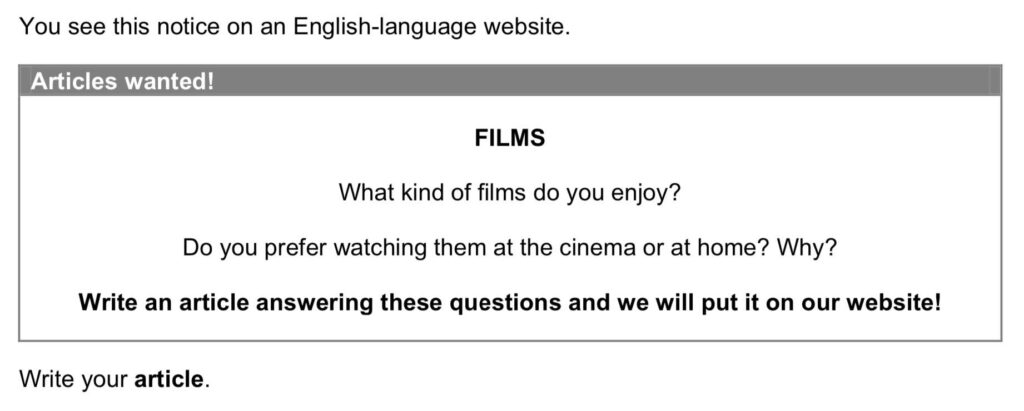
Example of Writing B1 Part 1: Article
Thrillers are my favourite films!
Watching films is one of my favourite hobbies. I try to watch one or two films every week. However, I don’t enjoy all kinds of films. My favourite type is thrillers.
I like thrillers because the story is usually very interesting and you cannot guess the ending. I also think that the actors and directors do a great job.
I think the best place to watch a film is the cinema. The screen is very big, the seats are comfortable and you can eat popcorn. For this reason, I try to go to the cinema every weekend.
What about you? Do you like thrillers? What kind of films do you like?
If you look closely, each paragraph focuses on one of the ideas posed in the task:
- Introduction: Introduction for What kind of films do you enjoy?
- 2nd paragraph: Development of What kind of films do you enjoy?
- 3rd paragraph: Do you prefer to watch them at the cinema or at home? Why?
- Last paragraph: I ask a question to the reader, since it is a website where they can likely leave comments.
Writing B1 Preliminary: Story
In this case, the writing task must also be about 100 words, but instead of an email or an article, you have to write a story.
I think writing a story is more difficult than writing an article because we are more used to writing articles at school. A story usually needs more verb tenses and more creativity.
However, if you are creative, writing a story can be a great choice for you. It can be easier and more fun, and you can make it really interesting.
In the end, it depends on your skills and what you feel most comfortable with.
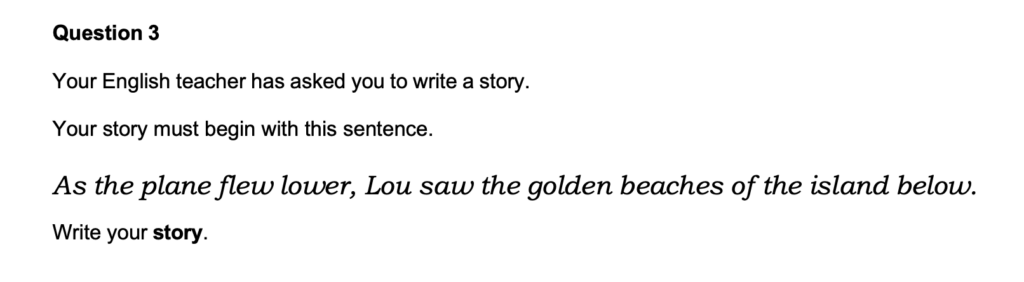
Example of Writing B1 Part 1: Story
The Island Secret
As the plane flew lower, Lou saw the golden beaches of the island below. She was excited because she was going to spend two weeks there with her friend Mia. They arrived at a small hotel near the sea and went for a walk.
While they were walking, they found an old path in the forest. It led to a hidden cave. Inside, Lou saw a box with a map and a strange note. The note said the map showed the way to a treasure.
Lou and Mia followed the map and found a small chest under a tree. Inside there were old coins and a letter explaining that the treasure belonged to the island’s people. They decided to give it to the local museum. Everyone was very happy.
If you look closely, the layout of a story is the following:
- Title: The title should summarize the entire story or, at least, be related to the main theme.
- Exposition: This is the beginning of the story, where the characters and the setting are introduced. It is basically the introduction to the next part, the climax, and the plot of the story.
- Action: In this part, the characters face the main action and look for ways to resolve the plot.
- Resolution: This is where the action is resolved and the story concludes with an ending, usually without any loose ends.