Writing A2 KEY (KET) - Guide
What is A2 Key Writing like?
In the Writing section of the A2 Key exam, candidates complete two tasks included in Paper 1 (Reading and Writing), which lasts 1 hour in total. It is advisable to spend about 20 minutes on the Writing tasks and use the remaining 40 minutes to answer the five Reading sections.
The Writing section consists of:
Part 6: Write a short email or note (at least 25 words).
Part 7: Write a story based on pictures (at least 35 words).
These tasks assess your ability to communicate effectively in everyday situations, using grammar and vocabulary appropriate to A2 level.
Types of A2 Writing
A2 Key Writing: Part 6 – Email or short note
In the first part of the Writing section, you need to write an email or short note of at least 25 words. What does “at least 25 words” mean? It means this is the minimum number of words required for your answer to be marked. However, I strongly recommend writing close to 40 words. This allows you to include all the necessary information clearly and fully, without making your answer too long.
Task characteristics:
Text type: Informal email or note to a friend
Word count: 25 words or more (aim for around 40 words)
Score: 15 points
Content: You must answer the 3 specific points mentioned in the task
Now, let’s look at a real example from A2 Key Writing Part 6.
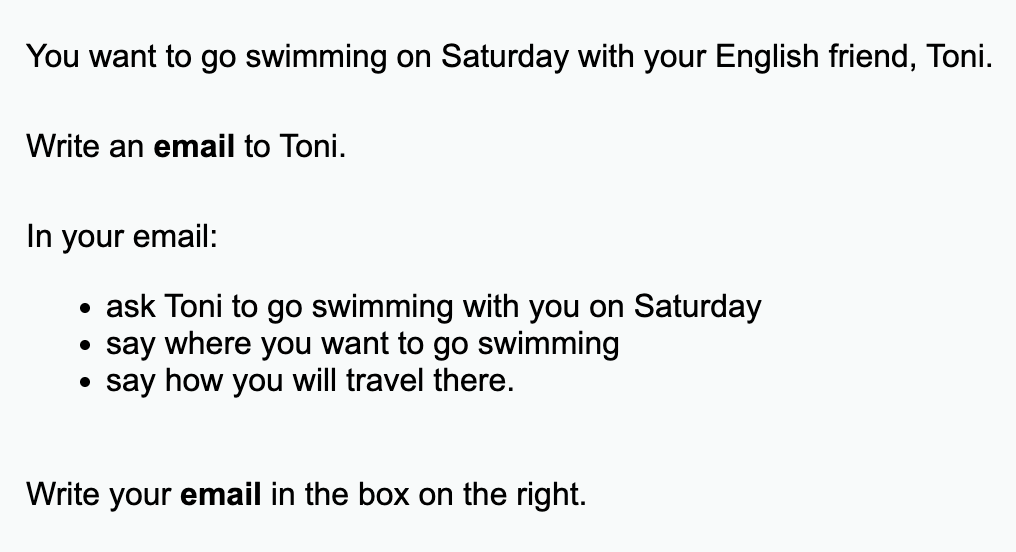
A2 Writing Part 6 Example: Email or short note
Hi Toni,
The weather will be nice on Saturday, so I’d like to go swimming. Would you like to come with me? I’m planning to visit the pool in the park. We can go by bus because it’s faster and cheap. What do you think?
Ale
Tips:
Practise writing short emails often. Try to write emails in English to your friends, even if they are very short messages.
Learn useful opening and closing phrases. Prepare some expressions you can use easily:
Opening: “Hi [name]!”, “Dear [name],”
Closing: “See you soon!”, “Take care!”, “Write back soon!”
Signature: Your name
Answer all three points. Read the three bullet points carefully and make sure you respond to each one. You can underline them or write quick notes before you start.
Use simple linking words. Words like “and”, “but”, “because” and “so” help your email sound clearer and more natural.
Use your own words. Try not to copy sentences from the task. Change the words and write the ideas in your own way.
A2 Key Writing: Part 7 – Story based on pictures
In the second part, you are asked to write a short story of at least 35 words based on three pictures. This task requires more creativity, as you need to describe a sequence of events using appropriate narrative vocabulary.
Task characteristics:
Text type: Short story
Word count: 35 words or more
Score: 15 points
Visual support: 3 pictures that show the sequence of the story
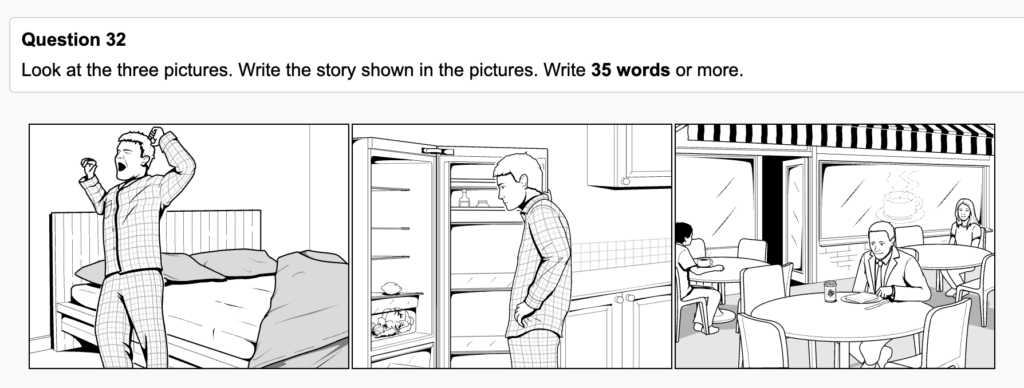
A2 Writing Part 7 Example: Story
Tom woke up at seven o’clock. He washed his face and wanted to make breakfast. When he opened the fridge, he saw there was nothing to eat. So he went to a café near his house and ate some toast for breakfast.
Tips:
Look carefully at the three pictures. Before you start writing, study them and think about the whole story: What happens first? Is there a problem? How does the story end?
Use past tenses. Stories are usually written in the past, especially the past simple: “woke up”, “went”, “was”, “had”.
Use time linkers. These words help organise your story:
To start: “One day”, “Yesterday”, “Last week”
To continue: “then”, “after that”, “next”
To finish: “finally”, “in the end”, “at last”
Practise writing short stories. Read simple stories in English and try writing your own stories based on pictures or everyday situations.
Add simple details. You can give the character a name, say what time it was, or describe how they felt. This makes your story more interesting but still easy to understand.
Include all three pictures. Make sure your story talks about something from each of the three pictures.